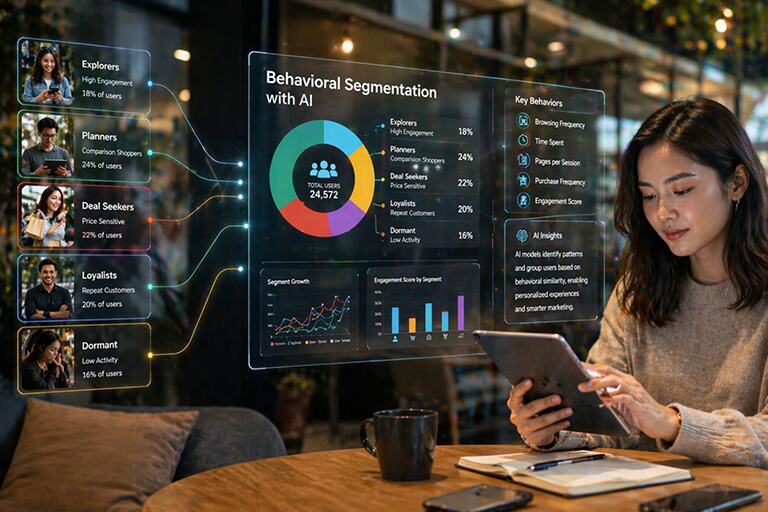
Behavioral segmentation with AI means grouping audiences based on what they actually do, not just who they are on paper. Instead of relying only on age, location, or industry, businesses can look at actions like repeat visits, abandoned carts, email clicks, content views, purchase timing, and re-engagement patterns. AI makes this more practical because it can process behavior at scale and surface patterns faster than manual segmentation usually can. For small and mid-sized businesses, that often leads to better timing, more relevant messaging, and campaigns that feel more connected to real customer intent. This is also why broader definitions of behavioral segmentation and current thinking around AI in marketing matter so much right now.
Why behavioral segmentation matters more than static audience targeting
A lot of businesses still build campaigns around broad audience labels and stop there. They may separate people into new leads, existing customers, or geographic groups, but those categories do not always reveal buying intent. Two people in the same city and the same age range can still behave completely differently. One might be researching, while the other is ready to buy. Behavioral segmentation closes that gap by looking at signals that actually reflect momentum. That is where AI becomes useful. It helps marketers identify action patterns faster and react before the moment passes. Instead of guessing which message belongs to which audience, the business can start using real behavioral clues to guide what gets sent, when it gets sent, and how specific the message should be.
What AI changes in the segmentation process
Traditional segmentation often depends on static rules. Someone fills out a form, joins a list, makes a purchase, or enters a CRM stage, and the system sorts them based on fixed conditions. AI adds another layer by identifying patterns that are harder to catch manually. It can detect clusters of high-intent visitors, highlight users who keep returning without converting, or flag customers showing early signs of disengagement. That gives marketers a more dynamic view of behavior instead of a frozen snapshot. In practical terms, that means audiences can shift based on what they do next, not just what they did once. For SMBs, that is especially valuable because smaller teams usually do not have time to rebuild segments by hand every week.
What kinds of behavior usually matter most
The best behavioral segments are usually built around actions that suggest intent, loyalty, hesitation, or drop-off risk. Page views, product comparisons, return visits, email clicks, repeat purchases, inactivity windows, and offer response history are often more useful than broad demographic labels because they say something about where a person is in the decision process. AI helps by finding meaningful combinations of those actions instead of treating every signal separately. For example, a user who clicks two educational emails, revisits a pricing page, and spends time on a service page is different from a user who opens an email once and disappears. That distinction is where more relevant messaging starts. The quality of segmentation usually improves when the business watches behavior that reflects movement, not just visibility.
How small businesses can apply it without making it too complicated
Most small businesses do not need a massive AI stack to use behavioral segmentation well. The smarter move is usually to begin with one campaign type and one meaningful behavior group. That might mean separating repeat site visitors from first-time visitors, active subscribers from dormant ones, or recent buyers from customers who have gone quiet. Once those patterns are clear, messaging can get more specific without becoming unmanageable. This works especially well when tied to email and re-engagement strategy. A business already working on segmentation strategies for better email engagement will usually get more from AI by refining those same segments instead of creating dozens of new ones. Simpler segments with clearer intent usually outperform complicated setups that nobody has time to maintain.
Where AI-driven behavioral segmentation creates the biggest lift
In real marketing work, the biggest gains usually come from better timing and more relevant follow-up. A person who repeatedly reads product or service content should not receive the same message as someone who has not engaged in months. A returning buyer should not get the same email as a cold lead. AI-driven behavioral segmentation helps adjust those paths with less manual sorting. This is one reason personalization improves when behavior is part of the strategy instead of an afterthought. Businesses that already focus on crafting personalized email campaigns that convert often see stronger results when behavior helps determine the sequence, not just the copy. AI does not replace the strategy, but it helps make the strategy more responsive to what customers are actually signaling.
Common mistakes that weaken the results
The biggest mistake is assuming AI can fix unclear data. It cannot. If the tagging is inconsistent, the CRM is messy, or the tracking setup is weak, the segments will still be weak. Another common issue is over-segmenting too early. Some teams create so many audience buckets that execution slows down and the message loses focus. I also see businesses rely too heavily on one signal, like email opens, without pairing it with stronger indicators such as repeat visits, product views, or purchase timing. Good segmentation is usually built on a few signals that matter, not every metric available. AI becomes useful when it simplifies decision-making, not when it adds more noise to an already messy system.
How retargeting gets smarter with behavioral signals
Behavioral segmentation becomes even more valuable when it connects directly to retargeting. Instead of running the same reminder ad to everyone who visited the site, a business can build different follow-up paths for different behaviors. Someone who viewed a pricing page may need a stronger conversion message. Someone who read educational content may need more trust-building first. Someone who abandoned a cart may respond better to urgency or reassurance. This is where AI helps make retargeting more precise instead of more repetitive. Businesses already focused on retargeting strategies for small businesses: how to bring customers back can usually improve performance by letting behavior shape which message appears next instead of sending one generic reminder to everyone.
How to know if it is actually working
Behavioral segmentation should improve outcomes, not just organization. If the strategy is working, the business should see stronger engagement quality, better click behavior, more relevant conversions, or improved win-back performance. In some cases, the clearest sign is not higher volume but better efficiency. Fewer wasted emails, better ad timing, and stronger repeat engagement often matter more than making the dashboard look more sophisticated. The real test is whether segmentation changes how customers respond. If the same content still goes to everyone in nearly the same way, then the AI layer probably is not being used strategically yet.
The bottom line on behavioral segmentation with AI
Behavioral segmentation with AI gives SMBs a more practical way to personalize their marketing without relying on broad guesswork. It helps businesses respond to real signals such as intent, hesitation, loyalty, and disengagement instead of treating every prospect or customer the same. The most effective approach is usually the simplest one: start with a few behaviors that clearly matter, connect those behaviors to messaging and follow-up, and let AI help surface patterns faster than a manual workflow can. When used well, behavioral segmentation does not just make campaigns feel smarter. It makes them feel more relevant, which is usually what improves performance in the first place.